TukoCare › Guides › Working with a caregiver
Working with a caregiverHow to hire and work with an in-home caregiver
Bringing someone into your parent’s home is an act of trust. Here’s how to find the right person, set them up to succeed, and stay confident about how each day is going — even when you can’t be there.
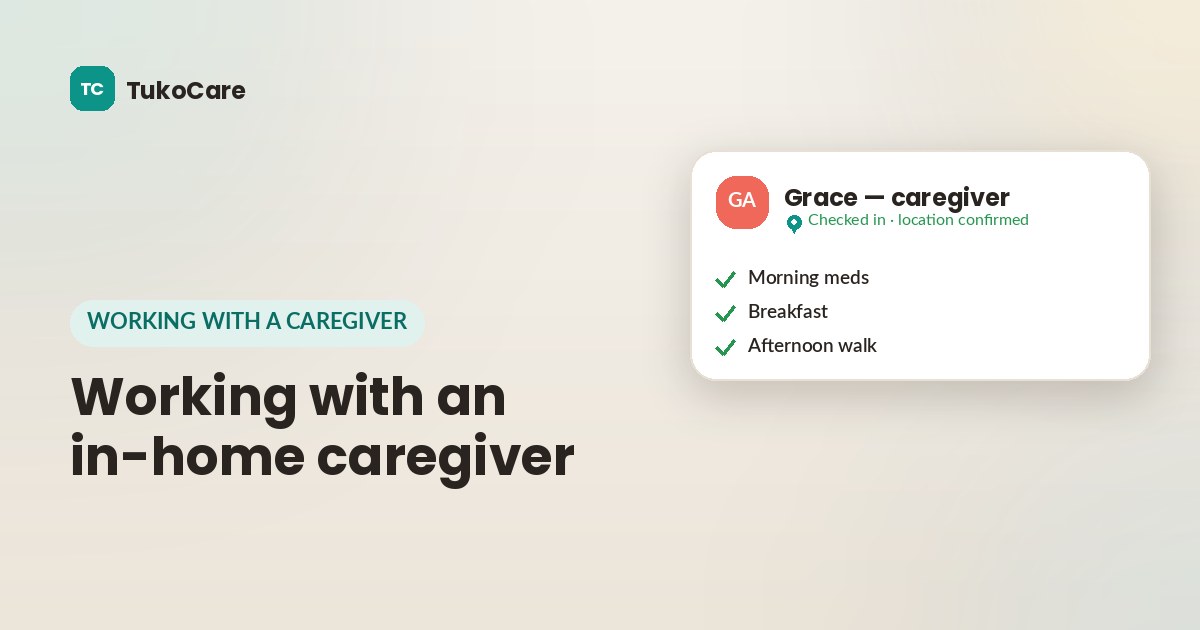
Figure out what you actually need
Before you interview anyone, get specific about the help your parent needs — because “a caregiver” can mean very different things. Broadly, in-home help falls into two buckets:
- Personal care and companionship — help with bathing, dressing, meals, medication reminders, light housekeeping, errands, and simply company. This is what most families need, and it doesn’t require a nurse.
- Skilled care — wound care, injections, managing complex conditions. This requires a licensed nurse or therapist, is usually ordered by a doctor, and is often time-limited.
Write down the actual tasks and the hours you think you need each week. Be honest about the hardest moments of the day — mornings, bedtime, mealtimes — because that’s where help matters most. This list becomes the job description, the interview guide, and later the care checklist the caregiver works from.
Agency vs. hiring independently
You’ll usually choose between hiring through a home-care agency or hiring an independent caregiver directly. Both can work well; they trade off differently.
Home-care agency
The agency employs the caregiver, handles payroll and taxes, runs background checks, carries insurance, and — importantly — provides a backup when your caregiver is sick or on vacation. You typically pay more per hour, and you may not always get the same person. For most families, especially long-distance ones, the reliability and vetting are worth the premium.
Independent caregiver
Hiring directly often costs less per hour and lets you build a close, consistent relationship with one person. But you become the employer: you handle vetting, taxes, backup coverage, and the awkward conversations. If the caregiver doesn’t show up, there’s no agency to call.
In the United States, ordinary long-term in-home care is generally not covered by standard Medicare, though Medicaid, long-term-care insurance, and veterans’ benefits may help depending on the situation. Costs vary widely by region. Confirm what applies to your family before you commit — a hospital social worker or your local Area Agency on Aging can help you sort it out.
Where to find a good caregiver
Good caregivers are most often found through:
- Referrals — ask your parent’s doctor, a hospital discharge planner, friends who’ve been through it, or a faith community. A warm referral beats a cold listing.
- Licensed home-care agencies in your parent’s area — look for ones that are established, properly licensed for your state, and willing to answer hard questions.
- Area Agencies on Aging — a free, government-supported starting point that can point you to vetted local resources.
- Reputable caregiver marketplaces — useful for independent hires, but do your own vetting; the platform’s screening is a floor, not a guarantee.
Interviewing: what to ask
Interview more than one candidate, and if you possibly can, include your parent — the personal fit matters as much as the résumé. Beyond experience and availability, ask questions that reveal how someone thinks:
- “Tell me about someone you cared for. What was a hard day like, and how did you handle it?”
- “What would you do if my mother refused to take her medication?”
- “What would you do if you arrived and she’d had a fall?”
- “How do you like to keep families informed?”
- “Are you comfortable with our routine and the tasks on this list?” (share the list you made)
Listen for warmth, patience, honesty, and a sense of responsibility — someone who talks about the people they cared for as people, not tasks. Watch how they interact with your parent. A skilled caregiver who your parent dislikes is not the right hire.
Vetting: references and background
Whether through an agency or independent, insist on the basics:
- References — and actually call them. Ask former families: “Would you hire this person again? What should I know?”
- Background check — agencies should run these; for independent hires, use a reputable service and get written consent.
- Credentials as relevant — certification (such as a certified nursing assistant or home health aide), CPR/first-aid, a valid driver’s license if driving is involved, and proof they can legally work.
- For agencies — ask about licensing, insurance and bonding, how they screen and train, how they handle backup coverage, and how they supervise their caregivers.
Know how every visit went — not just when there’s a problem
With TukoCare, your caregiver checks in on arrival (location confirmed), works the care checklist, and posts notes and photos — and you see it live. Free forever.
Start free Try the live demoSet the role up for success
Most caregiver relationships that go wrong don’t fail because of a bad person — they fail because of unclear expectations. Set the role up properly from day one:
- Write a simple care plan. The routine, the must-do tasks, food likes and dislikes, medication times, mobility needs, and any medical watch-outs. Keep it where the caregiver can see it, not in your head.
- Agree on the schedule and pay in writing, including how time is tracked and what happens if a visit needs to change.
- Introduce them to the important details — how your parent likes things done, what soothes them on a bad day, who to call in an emergency.
- Decide how you want to be kept informed — and make it easy, so it actually happens.
That last point is the one families underestimate. A caregiver who is happy to keep you posted will still fall behind if “keeping you posted” means remembering to text three different relatives every evening. Give them one simple place to log the visit, and updates become effortless.
Trust, but verify — the right way
Here’s the honest tension at the heart of hiring a caregiver: you want to trust them completely, and you also want to know what’s actually happening in your parent’s home when you’re not there. Those aren’t in conflict — good caregivers welcome a clear record, because it protects them too and shows the family everything they do.
The right kind of oversight isn’t surveillance. It’s a shared log of the care itself. This is precisely what TukoCare provides. Your caregiver checks in when they arrive — and because the location is confirmed, you can see a green “confirmed” only when they’re genuinely at the home. They work through the care checklist you set, add notes and photos, and check out when they leave. You (and any family you’ve invited) see all of it in real time, with timestamps. No cameras in the living room, no chasing for updates — just a clear, shared account of each visit.
It also gives the caregiver a fair, documented record of everything they did — which matters on the day a worried relative asks “did anyone actually take Mom for her walk?” and the answer is right there.
The best caregivers don’t resent a clear record of their work — they rely on it. Transparency turns “are you sure?” into “thank you.”
Red flags and when to move on
Stay alert to warning signs, especially early on:
- Chronic lateness, no-shows, or vague answers about how the day went.
- Your parent seeming anxious, withdrawn, or reluctant around the caregiver.
- Unexplained missing money, medication, or belongings.
- New bruises, poor hygiene, weight loss, or a decline in mood that the caregiver can’t explain.
- Resistance to keeping any record of visits, or defensiveness when you ask normal questions.
Trust your instincts and your parent’s. Most caregivers are dedicated, kind people doing hard work for modest pay — but your job is to protect your parent, and a professional will understand that. If something feels wrong and doesn’t improve after an honest conversation, it’s okay to make a change.
The first two weeks set the tone
The beginning of a caregiving relationship shapes everything that follows, so invest in it. Don’t just hand over a key and hope for the best. If you can, be present — in person or by video — for the first visit or two, and treat the first fortnight as a shared trial for both sides.
A few things to do deliberately in those early days:
- Walk through the routine together rather than only describing it. Show, don’t just tell — where the medications are, how your mother likes her tea, which chair is hers, what the evening wind-down looks like.
- Introduce the people and the emergency plan. Who to call, where the important paperwork lives, how to reach you, and what counts as “call me right away” versus “mention it in today’s notes.”
- Encourage questions. A caregiver who asks a lot in week one is usually the conscientious kind. Silence isn’t always confidence.
- Check in with your parent privately after the first few visits. Do they feel comfortable? Respected? Listened to? Their read matters more than any résumé.
- Give feedback kindly and early. If something isn’t being done the way you need, say so gently now, while habits are still forming, rather than letting frustration build.
Plan for time off from the start, too. Everyone gets sick and takes vacations; decide in advance what happens when your caregiver can’t come, whether that’s an agency sending a substitute or a family member stepping in. A backup plan made calmly beats one improvised in a panic.
Finally, use those first two weeks to establish the habit of the shared visit log. When logging each visit becomes routine from day one — check in, work the checklist, add a note or photo, check out — it stays effortless, and you build a complete record of the care from the very beginning. It’s far harder to introduce that habit months later than to start with it.
Common questions
Is it better to hire through an agency or independently?
Agencies cost more but handle vetting, taxes, insurance and backup coverage — usually the safer choice for busy or long-distance families. Hiring independently costs less and can build a closer bond, but you take on the employer responsibilities and the risk if your caregiver is unavailable.
How can I keep an eye on care without installing cameras?
Use a shared visit log instead of surveillance. TukoCare lets the caregiver check in with a confirmed location, complete a care checklist, and post notes and photos, so you see exactly what happened each visit — respectfully and transparently, for everyone.
What should be in a caregiver’s daily routine?
Whatever your parent needs most — typically medication reminders, meals and hydration, personal care, some activity or a walk, light housekeeping, and companionship. Write it down as a simple checklist so nothing is left to memory.
How do I introduce a caregiver to a parent who doesn’t want help?
Start small and frame it around independence: a few hours a week, presented as help with specific tasks (a ride, a meal, some company) rather than “a caregiver.” Let the relationship build. Including your parent in the hiring choice makes acceptance far more likely.
Give your caregiver one simple place to keep you posted
TukoCare turns every visit into a clear, shared record — verified check-ins, checklists, notes and photos. Free forever; add Tunza AI free for 14 days.
Create your care circle