AssignMe › Guides › Running a smooth shift
For charge nursesThe charge nurse’s guide to running a smooth shift
The charge nurse sets the temperature of the whole unit. Here’s how experienced leaders start strong, stay ahead of the chaos, and keep the shift calm even when it isn’t.
Start before the shift starts
A smooth shift is mostly won in the first 20 minutes. Get in a little early, take report on the unit as a whole, and build the assignment with intention — balancing acuity, matching skill to need, protecting continuity, and clustering rooms. (Our guides on fair assignments and acuity cover the how.) Scan for the day’s likely pressure points: who’s unstable, which discharges are expected, which admissions are coming, who’s going off the floor for procedures. Walking in with a plan — instead of reacting from behind — is the difference between leading the shift and being dragged through it.
Run a tight huddle
A quick, focused start-of-shift huddle aligns the team in a couple of minutes and prevents a dozen small problems. Keep it short and useful:
- Flag the sickest and highest-risk patients and who has them.
- Note the expected admissions and discharges and any bed pressure.
- Call out safety concerns — fall risks, isolation, one-to-ones, equipment issues.
- Confirm the plan for breaks and who covers whom.
- Share any staffing or resource notes — who’s new, who’s floating, where the help is.
A team that knows the shape of the shift from the first minutes moves as a unit instead of a set of individuals.
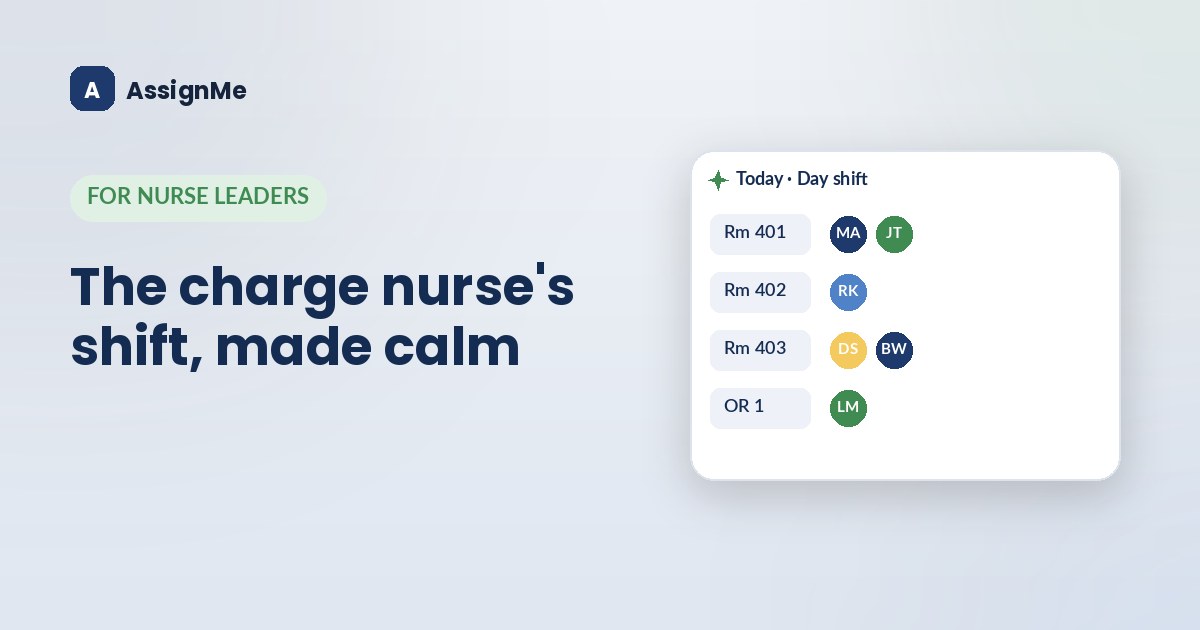
Half of a charge nurse’s interruptions are “who has room 12?” and “where’s my patient going?” A single, live assignment board that the whole team can see — and that updates when things change — answers those questions without a trip to the charge desk, and keeps everyone working from the same picture.
Stay ahead of flow
The rhythm of a shift is set by admissions, discharges, and transfers. Get behind on flow and the whole unit backs up. A few habits keep you ahead:
- Anticipate. Know which discharges are likely and prompt the paperwork early so beds open when you need them.
- Spread admissions fairly. Don’t drop three new admissions on one nurse because it’s convenient — rotate them and account for the workload burst each one brings.
- Round on your team, not just your patients. A quick check with each nurse mid-shift catches the nurse who’s quietly underwater before it becomes a crisis.
- Rebalance when acuity shifts. When a patient crashes or a heavy admission lands, move one thing rather than letting a nurse sink — and keep everyone else where they are so the change doesn’t ripple.
Handle a call-out without breaking the board
A late call-out is the classic shift-wrecker. The instinct is to reshuffle everything — but that destabilizes the whole unit and confuses everyone. The better approach is to patch the gap with the fewest changes possible: absorb the open patients by extending neighbors or moving a single person, keep everyone else exactly where they are, and never leave an area uncovered during the change. Then say clearly what changed and why. Minimal, transparent adjustments keep the shift stable where a full reshuffle would tip it over. A tool that lets you re-cover a gap in a few taps — and shows the coverage picture as you do — turns a stressful scramble into a two-minute fix.
Set up a clean handoff
How you end the shift sets up the next one — and a good handoff is a safety event. Toward the end, make sure loose ends are tied or clearly flagged, keep continuity in mind as you think about the next assignment, and leave a concise note for the oncoming charge nurse: staffing, what changed, gaps, and what to watch. The oncoming team should be able to pick up a clear picture, not reconstruct one. Ending organized also means you actually leave on time.
Lead calmly under pressure
On a hard shift, the team takes its cue from the charge nurse. If you’re visibly frazzled, everyone tightens up; if you’re steady, the unit steadies. Stay calm and available, help hands-on when you can, protect your nurses from unnecessary pressure, and keep communicating — a team that knows what’s happening copes far better than one left guessing. You won’t control everything a shift throws at you, but you can control the tone, the plan, and how fairly the load is shared. That’s what makes a shift feel smooth even when it’s busy.
One live board your whole team runs on
AssignMe gives the charge nurse a fast way to build, share and adjust the assignment — huddle to handoff, call-out to rebalance.
See how it works Request a demoYou can’t control what the shift brings. You can control the start, the plan, and how fairly the load is shared — and that’s most of a smooth shift right there.
Handling a difficult moment with a nurse
Sooner or later a nurse will push back on their assignment — sometimes fairly, sometimes not. How you handle it shapes the whole team’s trust in the board. A few principles keep these moments from becoming shift-long tension:
- Listen first, in private. Pull them aside rather than debating at the desk in front of everyone. Often the real issue isn’t the assignment itself but feeling unheard.
- Explain the reasoning. “I gave you the fresh post-op because you’ve got the experience for it, and I kept your count to three because those are heavy” lands very differently than “that’s just how it is.” Transparency turns a complaint into a conversation.
- Be willing to adjust when they’re right. If a nurse is genuinely overloaded, fix it — moving one thing is cheaper than a nurse who’s underwater and demoralized all shift. Flexibility isn’t weakness; it’s good leadership.
- Hold the line when you need to. Sometimes the assignment is fair and someone simply drew a hard day. You can acknowledge that it’s tough, offer to help hands-on, and still keep the board as it is.
The through-line is respect: nurses accept a hard assignment far more readily when they feel their charge nurse sees them, has a reason, and has their back. A board everyone can see — built visibly on acuity and skill — removes most of the “this is unfair” friction before it even starts, because the fairness is right there for anyone to check.
Common questions
What’s the most important thing a charge nurse does for a smooth shift?
Start strong: come in early, build a balanced assignment, and run a tight huddle so the whole team knows the day’s pressure points from the first minutes. Most of a smooth shift is set up before it begins.
How should a charge nurse handle a call-out?
Patch the gap with the fewest changes possible — extend a neighbor or move one person, keep everyone else in place, never leave an area uncovered, and clearly explain what changed. A minimal, transparent fix keeps the unit stable where a full reshuffle would destabilize it.
What makes a good end-of-shift handoff?
Loose ends tied or clearly flagged, continuity considered for the next assignment, and a concise note for the oncoming charge nurse covering staffing, changes, gaps, and what to watch — so they pick up a clear picture rather than reconstructing one.
How does AssignMe help run the shift?
It gives the charge nurse one live, shareable board to build and adjust in seconds, shows coverage so gaps and overloads are obvious, and makes re-covering a call-out a quick, minimal change — from huddle through handoff.
Run a calmer shift
AssignMe is the shared assignment board for charge nurses — hospitals, LTC, clinics and home care.
Request a demo