AssignMe › Guides › Fair assignments
For charge nursesHow to make fair nurse assignments
A good assignment is invisible; a bad one poisons the whole shift. Here’s how experienced charge nurses build assignments that are balanced, safe, and fair — and keep the team’s trust.
Why a fair assignment matters
The shift assignment is one of the most consequential decisions a charge nurse makes, and it’s made under time pressure before the day even starts. Get it right and the unit hums; nurses can give good care, breaks actually happen, and patients are safe. Get it wrong — one nurse buried while another coasts — and you get missed care, burnout, errors, and a team that quietly stops trusting the board. Fairness here isn’t about being nice; it’s a patient-safety and retention issue.
Balance by acuity, not just headcount
The classic mistake is dividing patients evenly by number. Four patients each sounds fair — until you realize one nurse has four stable, near-discharge patients and another has a fresh post-op, a confused fall risk, a complex drip, and an active decline. Same count, wildly different workloads.
Fair assignments balance acuity — how sick and how demanding each patient is. Whether your unit uses a formal acuity tool or the charge nurse’s judgment, the goal is to spread the heavy patients so no single nurse carries a disproportionate share of the sickest. When you group the two most demanding patients on one nurse, you’ve set that nurse up to fall behind and that patient to wait. (For more on this, see our guide on acuity-based assignments.)
Look at the finished assignment and ask: “Would I be comfortable taking any one of these groups myself?” If one column makes you wince, your team will feel it too. Even out the outliers before the shift starts, not after someone’s drowning.
Account for the hidden workload
Acuity isn’t only about how sick a patient is on paper. A lot of nursing time goes to things that don’t show up in a diagnosis:
- Total care needs — a heavy, immobile patient requiring frequent turns and full assistance can take more time than a sicker but independent one.
- Admissions and discharges — each is a burst of paperwork and coordination. Don’t stack the likely discharges and expected admissions all on one nurse.
- Family dynamics — an anxious family or a difficult situation can consume a shift.
- Confusion and safety — a delirious or fall-risk patient needs near-constant attention.
- Isolation, drips, procedures, and off-unit trips — all real time that a headcount hides.
Weigh these alongside clinical acuity. The nurse with the “lightest” patients on paper may be the one with three total-care patients and two families in crisis.
Match skill and experience to need
Fair doesn’t mean identical. It means matching the right nurse to the right patients:
- Give the most complex or unstable patients to experienced nurses who can manage them safely.
- Keep newer nurses’ loads lighter and their patients more stable, and seat them near an experienced colleague or their preceptor.
- Respect competencies — certain drips, devices, or patient types may require specific training.
- Don’t punish your strongest nurses by always handing them the hardest load with no relief — that’s how you burn out the people you rely on most.
Protect continuity and geography
Two practical factors make a big difference to how an assignment actually plays out:
- Continuity of care — where possible, keep a patient with a nurse who cared for them yesterday. It’s safer (the nurse already knows the story), more efficient, and better for the patient. Balance this against not overloading that nurse.
- Geography — keep each nurse’s rooms clustered so they’re not sprinting from one end of the unit to the other. A nurse whose patients are scattered loses real time to walking and can’t keep eyes on everyone.
Keep it fair over time
Fairness isn’t just today’s board — it’s the pattern across shifts. If the same nurse always draws the heaviest hallway, or the same person always gets the “easy” assignment, resentment builds even when any single day looks defensible. Good charge nurses rotate the tough assignments, spread admissions fairly, and can point to why a given board looks the way it does. Transparency defuses most conflict: when nurses can see the assignment was built on acuity and reason rather than favoritism, they accept a hard day far more readily.
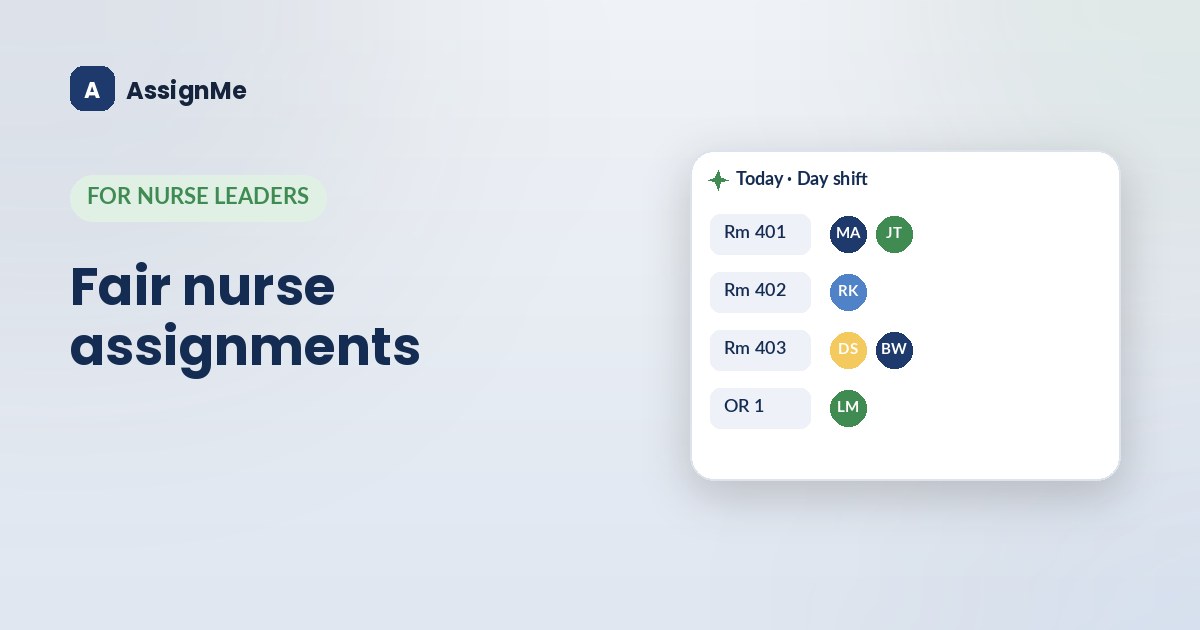
This is precisely where a purpose-built tool earns its keep. AssignMe lets a charge nurse build and balance the board in minutes, weighing acuity, skill, and continuity, and shows a clear coverage picture so lopsided loads jump out before the shift starts. It keeps a history of recent shifts, so you can spread the heavy assignments fairly over time — and everyone can see the same live board, which is half the battle for trust.
Build a fair, balanced board in minutes
AssignMe helps charge nurses balance acuity and workload, keep continuity, and share one live assignment the whole team trusts.
See how it works Request a demoA fair assignment isn’t the one that’s mathematically equal — it’s the one where every nurse can safely carry their load, and can see why it was built that way.
From the whiteboard to a shared board
Most units still build assignments the old way: a dry-erase board at the charge desk, rewritten by hand each shift, visible only to whoever is standing in front of it. It works, but it costs the charge nurse time and it leaves the rest of the team in the dark until they walk over to look. When something changes mid-shift — a call-out, a crashing patient, a surge of admissions — the whole thing gets erased and redrawn, and for a few minutes nobody quite knows who has whom.
Moving the assignment onto a shared, digital board fixes several of these problems at once. The charge nurse builds it faster, with the acuity and workload weights visible so imbalance is obvious before the shift starts. Every nurse can see the current board from anywhere on the unit — no trips to the desk, no “who has room 12?” The board updates in real time when something changes, so a mid-shift adjustment is a small, clear edit instead of a confusing erase-and-rewrite. And because the history is kept, you can look back and make sure the heavy assignments are being shared fairly over days and weeks, not just balanced within a single shift.
That’s the gap AssignMe was built to close. It keeps everything good about a charge nurse’s judgment and adds the speed, visibility, and fairness-over-time that a whiteboard simply can’t. The goal isn’t to replace the charge nurse’s expertise — it’s to give that expertise better tools.
Common questions
What makes a nurse assignment fair?
Balancing by acuity and true workload rather than headcount, matching complex patients to experienced nurses while keeping new nurses’ loads lighter, protecting continuity and geography, and spreading the hard assignments fairly across shifts — with enough transparency that the team can see the reasoning.
Should patients be divided evenly by number?
No. Equal numbers can hide very unequal workloads — one nurse’s four patients may be far heavier than another’s. Balance the acuity and care needs, not just the count.
How do I keep assignments fair over time?
Rotate the toughest assignments, spread admissions and discharges, and track recent shifts so the same nurse isn’t always carrying the heaviest load. A tool that keeps assignment history makes this easy to see and act on.
How does AssignMe help?
It lets a charge nurse build and rebalance the board quickly with acuity and skill in mind, flags coverage gaps and lopsided loads, keeps a shift history for long-term fairness, and shares one live board the whole team can see.
Give your unit a board it can trust
AssignMe turns the daily assignment into a fast, fair, shared process — for hospitals, LTC, clinics and home care.
Request a demo